Showing posts with label auto. Show all posts

Tuesday, May 8, 2012

How-To: Make 37 Degree AN Hard Lines

Story and Photos by Matthew Eddy


OEM brake tubing in the US have what is called a 45° double flare at the ends which means the end of the tubing is folded in on itself and flare at 45°.  A flare nut then crushes the tube end against the mating surface to make seal.  After the flare has been crushed it will require more torque to seal seal each time the system is disassembled and reassembled as well as the potential for fatigue cracks to form where the metal has been folded over.  This is fine for the commuter-consumer they aren’t going to be swapping out components from week to week or season to season.  Racers tend to tinker with their cars and may have to dismantle everything or replace components frequently so they need components that are designed to be disassembled and reassembled multiple times.  The 37° AN flare is a single flare is backed up by a tube sleeve that is held to the mating part with a nut and is capable of being disassembled multiple times without fatiguing and since it’s a single flare its actually easier to make than a double flare.  Additionally this method is rated at higher pressures and is held to a higher standard so the system is more robust and can endure the extremes of racing.  It is fairly common for a race team to immediately replace all stock brake lines with the 37° AN flared tubing as part of prepping the car for racing.
The down side of the AN flare is that the components are much more expensive and they also require an adapter to connect them to the stock brake components such as the master cylinder, proportioning valves and ABS block.  Also the tools tend to be more expensive but you can find a 37° flare tool on Summitracing.com for about $30 HERE.   If you decide to upgrade your brakes to the AN fittings then you can save yourself some money and time by only replacing the lines that run from the ABS block  (or the proportioning valves for those cars without ABS) to the calipers and leave any plumbing that might be going from the master cylinder to portioning valves or ABS block. The AN fittings can also be used for routing fuel, vacuum lines, and various other fluids.  Make sure to use STEEL fittings on the brakes or any other high pressure hydraulic systems and you can use aluminum fittings for anything else.

It is pretty easy to convert to AN flared lines but there are a few more parts you need to buy.  I would suggest getting stainless tubing and an appropriate tubing cutter because the $5 Acme Autoparts special will just cry when you try and cut a stainless line with them; they are barely adequate to cut a regular steel line.  Try this one from Mcmaster-Carr: part number 2764A14.  I haven't use this particular one but it does say its for stainless and titanium.

Step 1:  Cut the stainless tubing to length and deburr the ends.  PUT THE HARDWARE ON THE TUBE!  Easy to forget this step you get so excited about flaring the brake line and forget to put the hardware on.  So put on a TUBE NUT, then a TUBE SLEEVE.  Make sure they are facing the right direction.  See pictures at bottom. 

3/16" Stainless Brake Line Cut and Deburred.


Step 2: Clamp the tube into the flaring tool.  It should be sticking a little above the surface of the tool.  The one pictured below is from Summit Racing.  You can find it HERE.

Summit Racing 37 Degree Flaring Tool


Make sure you clamp this down TIGHT.  If its not tight enough the tube will just slide out.  I used a wrench as shown below to get it extra tight.


Use a Wrench to Tighten Flaring Tool.

Step 3: Flare it!


Summit Racing 37 Degree Flaring Tool in Action.

Successful 37 Degree Flare
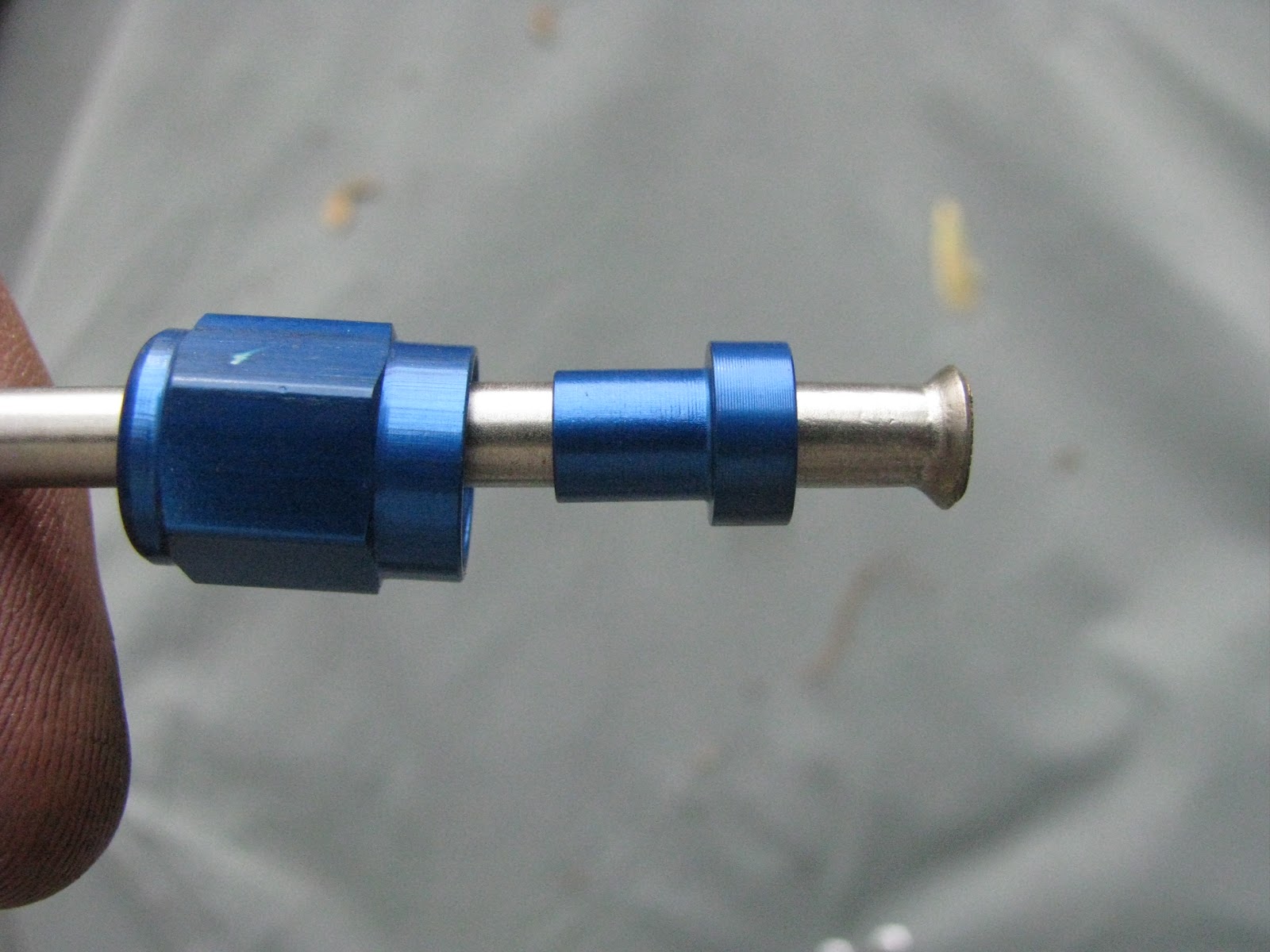
Here is a picture with all the hardware on behind the flare.  These are aluminum fittings, so this isn't to be used for brakes.  The steel ones usually are plain zinc. Left to right are the tubing nut with the threads on the right side followed by the tube sleeve.  The sleeve will be beveled on the side that will sit behind the flare. 


37 Degree -3AN Fittings on Stainless 3/16" Tubing.

37 Degree -3AN Fittings on Stainless 3/16" Tubing.

37 Degree -3AN Fittings on Stainless 3/16" Tubing


The adapters you will need to connect these to the master cylinder for instance look like this.  Most domestic car makers use 3/8-24 (I think) so need this adapter HERE.  Japanese tend to use M10x1.0 so you use this adapter HERE.  These adapters simply screw into the MC or proportioning valve then the new AN fittings screw to these.

Tuesday, February 28, 2012

Alfa Romeo Giulietta - aka Dodge Dart


Some of you may know that the Dodge is re-releasing the Dart later this year to fill the compact car opening in its vehicle line up.  Though the body will be Dodge its bones will be Fiat; more specifically the Alfa Romeo Giulietta.  Since I am not the die-hard buy American type I am actually pretty excited that Chrysler is using this chassis since the car may retain some of the Alfa’s character.  Even though Alfa Romeos are notoriously unreliable the Top Gear guys still love these cars.  Which means I will definitely take the opportunity to drive one when I get a chance.  I do like the body styling of the new Dart, and I hope its fun to drive.  According to a friend of mine who is a vehicle dynamics engineer with Chrysler said the engineers working on the Dart are trying to preserve the Alfa driving experience.  I hope they do.

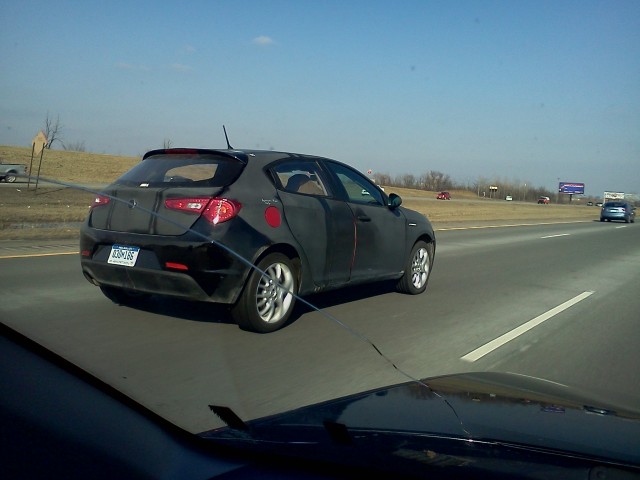
I can’t say there are many benefits to living in South East Michigan – like crumbling roads and loose rocks that crack windshields, but I do get to see a lot of the new cars in their razzle-dazzle or flat black paint schemes like this Alfa Romeo Giulietta mule I saw a couple days ago.  I can only speculate what Chrysler’s intentions are with this car; testing for the Dart, Fiat may release the Giulietta in the US, or they may use the platform for a number of other cars.  I heard a newer smaller Jeep model might use this chassis

Alfa Romeo Giulietta test mule painted flat black.

Alfa Romeo Giulietta test mule painted flat black.

Thursday, February 23, 2012

How to Choose Spring Rates

Spring Rates Calculator
Using Suspension Frequency to Help Determine Ideal Spring Rates for your car.

In the right margin of this blog I have posted a spring rate calculator.  It looks like a small excel spreadsheet and it will help you determine what spring rates will work best for your application.  Most consumers who are upgrading their suspension don’t think about spring rates they choose a coilover kit or brand of springs and bolt them on.  They may be basing their decision on opinions or reviews they read online and they may not be getting the best setup for their application.  When I say most consumers, a large majority of consumers are modding their cars for cosmetic reasons and aren’t actually intending to participate in any motor sports.  So for them, the spring rate is inconsequential because they are looking for either a good brand they can brag about or something that is inexpensive.  

If, on the other hand, you are interested in actually participating in some sort of motor sport like AutoX, track days, or racing, then a properly tuned suspension will give you an advantage over your competitors who may have only bought a recommended coilover package.  This isn’t necessarily a bad way to go since there are a lot of good coilover kits out there that are tuned for the car and application.  But understanding spring rates and how they can be used to custom tune your suspension to very specific tracks or your own driving style can give you an edge on the competition.  At the very least it will give you a better understanding of how the suspension works. 

You don’t need coilovers to adjust spring rates, but one advantage of coilovers is that the springs have a standard diameter and you will be able to find a variety of spring rates and lengths online.  Usually the rates will be available in 50lb increments.  This gives you much better suspension tuning options than an aftermarket spring kit that is designed to fit the stock spring locations.  These kits are cheaper since you don’t need to upgrade to coilovers but there won’t be a variety of spring rates available to choose from.

The standard spring rate measurement I will be using is lbs per inch which represents the amount of force in pounds it takes to compress a spring one inch.  For example a 400lb spring will compress one inch when 400lbs of force is applied.  The same spring will compress two inches when 800lbs are applied and four inches when 1600lbs are applied.  To give you some perspective a Ford Focus might have 80-150lb springs, a mildly built Miata might have 300lb springs and a full track car may have 600-2000lb springs.  Obviously the higher the spring rate the harder the ride. Bigger cars will also have stiffer springs since the springs will have to carry the weight of a heavier vehicle.  

It seems obvious to many why stiffer springs would be more desirable, but it may not be obvious to everyone.  A brief explanation is that a stiffer spring maintains to road contact, the car won’t lean as much in a turn, and it won’t bow as much under heavy braking.  The compromise is that the ride quality will be much harsher and that means less comfortable for daily driving. This will be covered in more detail in future articles.

Suspension frequency (SF) describes the natural frequency of the spring in relation to wheel motion and can be used to estimate the appropriate spring rate for various applications.  The calculation isn’t particularly difficult but will require either finding data or taking measurements of the car.  You can also use this to evaluate spring rates of various coilover kits and stock spring packages.  Most passenger cars will have a rate of approximately 1 Hz.  A fairly aggressive suspension setup will be around 2.0 Hz and a track dedicated car will have a frequency of around 3.0 Hz or more.  So you can use this information to figure out where on this spectrum of suspension frequencies will fit your application.  If you drive your car to the track or AutoX event you might want to try a SF a little over 2.0.  It is important to note that you want your rear SF to be slightly higher than your front otherwise the car might start to porpoise; rock forward and backward.  Also keep in mind that you will need to upgrade your dampers (aka shocks) to handle springs that are stiffer if you haven’t done so already, especially if you choose a very aggressive spring rate.   

The spring rate calculator on the right is fairly simple to use.  Figure out what suspension frequency you want, update the vehicle data for your car in the white cells and the ideal spring rate will update in the yellow.  Everything in gray should be left alone and the calculated spring rates will be yellow.  For now none of the cells are protected so you could go in and modify any of them but none of the changes will be permanent.  If you make any mistakes, refresh the page and it will reset the calculator.  The spring rates are calculated for individual corner of the car but since the left and right side should be essentially the same the calculator will only calculate front and rear. If you want some more background information check out the Eibach website.  Please note for a live axle or solid beam axle this calculator will not work.

User Inputs:

Race Weight - This is the weight of the car with fully suited driver, and fuel.  If the car is stock, take the curb weight, add your own weight when fully suited, and a little extra for incidentals.
Weight Distribution Front - percent of the total weight of the car in the front.  You can use stock data to get you close.
Unsprung weight - this is the weight not supported by the springs, so this is the weight of the wheels, tires, hubs, brake caliper, half the control arm, etc.  You can estimate this weight and it will probably be somewhere between 80-100lbs per corner.  Keep in mind that particularly large wheels will be significantly heavier and may push your unsprung weight well over 100lbs per corner.  Since some cars have staggered wheels the unsprung weight from front to rear may be very different.
Spring Angle - if you have a McPherson Strut, you can estimate the angle at 5-10 degrees.  Otherwise you need to determine what angle from vertical the spring/coilover/strut is mounted in the car. 
D1 & D2 - D1 is the distance from the spring mount on the control arm to the control arm pivot point. D2 is the distance from the ball joint to the control arm pivot point.  The units aren't important as long as they are the same (mm, inches, feet, furlongs or whatever). If you have a McPherson strut, then leave these numbers alone since 98/100 is the approximate ratio.  You will see you need to do this for the front and rear.  If you are a Mustang owner and have a live axle, just do it for the front since this is not setup for solid axle setups. 

Everything in gray should be left alone since it is either calculated for you based on the info you entered in the white cells or cell descriptors but I will explain what the various measurements are.

MR - Motion Ratio, this is the ratio of the motion of the wheel to the motion of the spring.  This is calculated by taking D1 and dividing it by D2.  That is why the units of measure aren’t important, since we are using them to calculate a ratio.
ACF (Angle Correction Factor) - This is needed to accurately calculate the how much the spring compresses in relation to the wheel motion.
Front and rear Sprung Weight - In this formula, this is calculated based on the weight distribution and unsprung weight.  In this current configuration, the unsprung weight is considered to be the same for front and rear wheels.  I will update it shortly so that you can put unique values for the front or the rear.
Spring Rates - These are the required spring rates to achieve the desired suspension frequency.  You probably won’t be able to get a 212.3356 # spring, so you will have to decide if you want to with a 200# of 250# spring.  When deciding which way to go, remember that you want the rear SF to be slightly higher than the front, so look at both the front and rear SF before deciding. 

If you have any questions please feel free to leave a comment, and feedback would be appreciated.

Wednesday, February 15, 2012

Review - 2012 Abarth 500 - In the Snow!

Abarth 500 - US Version
Story and Photos by Matthew Eddy


Abarth 500 Logo.

I got to drive the Abarth (pronounced ahh-bart, or ahh-bath depending on who you talk to) 500 for 235 miles over 4 days in both sun and snow.  During that time I had 2 people ask if it was a Porsche, which amused me because this doesn’t look anything like any Porsche that has ever existed.  At least 3 people give me the thumbs up, and one guy told me I am going to get a lot of chicks with this car.  To be honest, I am not sure this would be the most powerful chick magnet, but it is sharp looking; at least from the side.  The face of the car has a very distinct European style that will only appeal to a minority of drivers. 


Abarth 500

Abarth is a factory tuner for Fiat similar to Chrysler’s SRT or Ford’s SVT group and they took a Fiat 500 and made it a bit sportier.  Of course, when I hear “sport car” I want to see some numbers; 160hp, 170 ft/lbs of torque in a car that weights 2535 pounds.  That is a good start, and for once the US market is getting a European car is that is more powerful than its European counterpart which only has 133hp.  It’s easy to see that the car is going to be quick and with its small wheel base, it will be nimble.  Besides the extra horses, Abarth lowered the car 1”, stiffened up the suspension, tweaked the front facia a bit and slapped a bunch of scorpion badges all over.  Actually the car doesn’t say “Fiat” anywhere on it. 

Like most cars these days the Abarth has Electronic Stability Control and Sport mode. Both of which can be turned on and off. When in Sport mode, the throttle response is sharpened up and you can call upon all 160 horses.  The ESC, in my snow driving experience, was probably designed for the Fiat 500 and was easily overpowered by the extra power.    It won’t perform the magic that EVO’s or GTR’s traction control can achieve by helping the driver negotiate a turn that they had over driven.  I was able to get wheel spin in 1st or 2nd when with the ESC on and it didn’t seem to be able to rein it in when I was hard on the throttle.  Also, from a stop, there were times I thought the ESC would stall the car because it bogged down the car so much.  It probably didn’t help that I am used to driving a Subaru and was a bit to aggressive with the throttle from a stop so when I was a little lighter on the throttle and feathered the clutch a bit more the Abarth was able to take off from a stop a lot more gracefully.  Overall the ESC was handy to have in the snow when you are driving sensibly, but it’s not very sophisticated and really only seems to try and control throttle induced wheel spin.  So don’t expect it to save you if you tear into a corner to fast.  Here is a video of me driving in the snow and playing with the ESC: http://youtu.be/IiQXgJRh2pE


Abarth 500 in the Snow at Night.

Abarth Wheel in Snow


In Sport Mode is activated by a button on the center console, and its pretty much just on or off.  When activated the throttle response is very noticeably sharper with the boost kicking in sooner and with more punch.  Perfect for when you are merging on to the freeway or need to pass some Sunday driver sleeping in the left lane.  Otherwise you can gust cruise around in normal mode to help conserve some fuel since that is probably part of the reason you would buy a small car.   

What is nice about the Abarth and the Fiat 500 in general is that if you are the Jolly Green Giant, you will find the car to be quite spacious.  Unless you are closer to seven feet tall you shouldn’t have any problems fitting into this car.  I am an even six feet tall and I had about 6” of head room.  So this car has plenty of room for you, a helmet and even a roll cage if you decide to race it. 

Besides being quick, my favorite feature of the car is the exhaust.  It sounds more like a muscle car than a little four banger with a turbo bolted to it.  I am now convinced that Italians inherently know how to tune an exhaust like no other.  It growls and gurgles like a V8; to bad it isn’t louder!  At freeway speeds it’s drowned out by road and wind noise because it’s just not that loud.  Here is a short video I shot so you can hear the exhaust note for yourself:  http://youtu.be/2Cy4ybqFlZo


Abarth Engine Bay - the turbo can be seen at the bottom of the image, its under and to the left the the silver heat sheild.


On regular roads the car felt pretty good even though the suspension is significantly stiffer than the Fiat 500.  As to be expected with any short wheelbase car on uneven pavement like we have all over the Detroit area, the ride can be pretty bumpy.  If you are shopping for any subcompact car, you won’t be able to avoid this issue  and I didn’t find it to be a problem.  This car would make a fun and comfortable commuter.  


Abarth 500 - Sporty Pedals

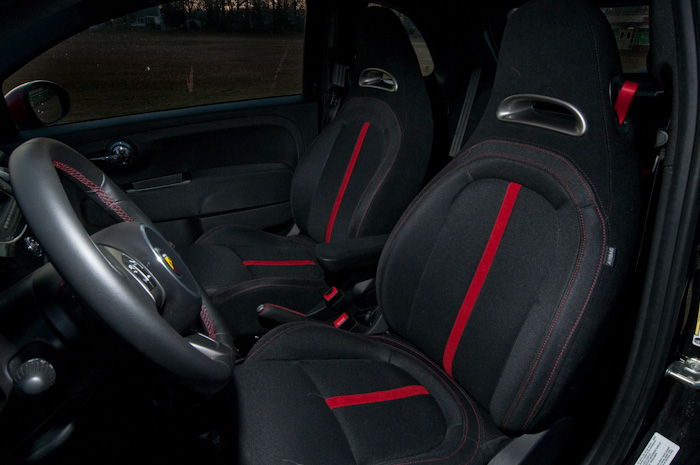
Abarth 500 - Seats - nice red detailing.


Performance & Handling

I wouldn’t call the Abarth fast, that label is reserved for cars whose 0-60 times are sub 5 seconds but it is definitely quick.  Though I haven’t see any official figures I am estimating it in the high 6 second range; probably a little slower than the Mini S comparing the power to weight ratios.  At a stop, in first gear, you can very easily get the front wheels spinning.   Actually, for me it was kind of hard to resist not doing it every time but that’s probably because I am like a kid with a new toy when I was driving this car.

The steering effort is firm and communicative.  As expected the car will tend to understeer, but that is to be expected from a FWD and manufactures will tune that into the car since its considered safer.  I don’t think it will take much to get it to be a bit more oversteery; different alignment and a larger rear sway bar should do the trick.  A few practice slaloms I tried the car felt very responsive with slight understeer developing toward the end.  Under hard corning the car was well balanced front to back but I was worried that the narrow track of the car and its height may make it prone to tipping.  I did see a picture of a 500 on two wheels through a corner and I think that made me a bit overly paranoid.  Plus I know I would never hear the end of it if I rolled the car, so I was aggressive, but didn’t push it to the limit under hard cornering. 

Overall the driving experience was very enjoyable and is a fun car to drive.  The performance of the car is such that I think you could surprise a few people with how quick it is.  I know I surprised a friend of mine when I spun the wheels launching it from a stop. 

Though is possible to nit pick any car, especially at this price point, the car has, only one major flaw; seating position.  My first thought when I got into the car was that I felt like I was getting into a van with captains chairs.  It even has a fold down arm rest!  This is great for commuting, but I was expecting a sports car.  I want to feel like I am getting into the cockpit of a F-16.  It felt so tall that I was at eye level with other drivers in full sized cars.  Some people might like this since the car, from the driver’s seat, doesn’t feel small.  However, I was just imagining this car just tipping over under hard cornering.  So much so that I would lean well over the passenger seat if I was really ripping through a corner.  Also, with this very vertical seating position I found my left leg was getting a cramp in my shin.  Basically, it was comfortable, but it didn’t feel sports car like and I had a hard time imagining myself taking this to a track. 

Abarth 500 - Steering Wheel and Dash Detail.


Abarth 500 Interior.


My only other complaint is the transmission wasn’t very smooth.  Sometimes I had to find 5th, and I got a crunch from the transmission when I was putting the car into reverse.  It wasn’t horrible, but a smoother tranny would improve the driving experience. 

I should also note that the back seats are really only usable for children.  There isn’t enough leg room or headroom for adults to sit back there comfortably.  If you are buying a subcompact then you probably already know that the backseats are decorative, or at the very least a convenient padded shelf to place luggage and weren’t actually expecting to seat people back there except in emergencies.  The trunk, on the other hand, is actually larger than you would expect.  You can probably hold at least one body if packed properly.

Looking at the car in a vacuum (not comparing it to any other cars), it is fun, quick, agile, looks good, and the exhaust sounds great.  This would make a great commuter and at around $22,700, the price it’s a fair amount less than other available turbocharged cars.   The problem is that the Abarth isn’t the only car in its class and it’s direct competition is the Mini Cooper S and some might also say the Mazda MX-5 Miata.  Originally I though I should compare it to a Ford Fiesta, Mazda2, Honda Fit and a few others but really none of them have a comparable model that comes close to the power of the Abarth.  So those cars aside, how does it compare to the Miata and the Mini? 

First off it beats them both in price.  The base MX-5 starts at about $23,500, and the Cooper S is at least $24,000, but you are probably looking at closer to $27,000 when comparably equipped for either car. In terms of fuel economy, the Abarth and the Cooper S are fairly similar.  I haven’t seen any official figures for the Abarth, but I am estimating that it will be approximately 30mpg on the highway compared to the Mini’s 32. Personally I got an average of 26mpg over 235 miles of combined city/highway driving but I was driving the least economical way possible so that doesn’t really is a fair assessment.  Where the Mini edges out the Abarth is the feel; the Mini feels sportier, the seating position is better and it has 181hp giving it a better power to weight ratio.   

If I had the money, I would buy a Mini over the Abarth especially if you plan to do some autoX or track days.  If you are serious about getting into motorsports than the MX5 would be the best choice since its rear wheel drive and has 167hp from a naturally aspirated engine.  But, if you like the looks of the Abarth and want a car that is kind of unique then take one for a test drive.  They are fun, sporty, comfortable, and would make a fun daily driver.


Saturday, November 12, 2011

Myth of Big Brake Upgrades

Lemans Car at Sebring - the red glow within the wheels are the rotors heating up in a braking zone just before a turn. Photo by Jeffery Ling


It is easy to believe that larger rotors and bigger calipers will make your car stop faster, but that is because most people assume that brakes stop the car, when in actuality they only stop the wheels.  This may seem like a minor distinction, but consider this: if you slam on the brakes and lock up the wheels (assume the car doesn’t have ABS for simplicity), does the car stop?  Not when traveling at speed it doesn't.  The car slides for a while with smoke billowing  and the tires screaming in agony.  At this point, stopping distance is determined not by the size of the rotor, or if they are cross-drilled, or Carbotech brake pads, but by the tires.  A quick side note: locking up the tires is never considered to be the fastest way to stop a car, but even still, it’s the tires that will have the biggest impact on the stopping distance of a car.

So, if the brake system only stops the wheels from turning, but doesn’t stop the car, then why use fancy drilled and slotted rotors, the $150+ race pads, and multi-piston calipers?  The answer is a bit more complicated and will require a short and hopefully painless foray into the world of physics.  The brake system of a car is an energy conversion system. It takes the energy of the car’s momentum and converts it to heat.  When you apply the brakes you slow down because your forward momentum is being converted into heat energy by the friction of the pads on the rotors.  If you slam on the brakes once, the car will slow down very quickly and your brake system will become very hot. If You then accelerate and do it again within a short time interval the brakes get hotter.  And if  you keep doing this, eventually you will put so much heat into the system that they don't work effectively any more, and the brakes will feel softer and softer until they don’t work any more.  This is called brake fade.  For those who have lived or driven in the mountains are already familiar with brake fade when descending a mountain.  If you haven’t had the chance to drive in the mountains then let me explain.  When heading down hill for an extended period of time you are constantly checking your speed with some braking inputs to keep you from accelerating.  If you don’t down shift and take some of the load off the brake system your brakes get so hot that they don’t work any more, and then your trip down the mountain becomes rather terrifying.  It is when you are stressing the brake system with repeated accelerating and hard braking like you would on a road track that a big brake system makes sense. 

Here is a list of common brake upgrades and what purpose they serve.  You will notice almost all of them deal with managing heat or increasing the heat tolerance of the system.

DOT 4 or 5 brake fluid – Most cars come with DOT3 brake fluid, which is perfectly fine for every day driving, but DOT 4 has a higher boiling point so the fluid can withstand higher temperatures so the brakes can get hotter before they start to fade.  I would highly recommend using at least DOT 4 in any track car.  DOT 5 is silicone based and has an even higher boiling point, but the brake lines need to be thoroughly flushed when converting a DOT 3/4 system to DOT 5 since the different fluids do not play well together.

Stainless Steel Brake lines – Brake lines in the car tend to be all hard lines except for a short flexible rubber section from the chassis to the caliper to allow for suspension travel.  When the brakes fluid heats up from heavy use, the rubber gets a little softer and allows the line to expand a little, which translates into a slightly softer pedal feel.  The stainless steel lines don’t allow the line to expand and so the brakes feel a bit stiffer and more consistent.  Also, the stainless steel is much more durable.

Racing Compound Brake Pads – If you go to your local auto parts store for pads they cater to the common driver who aren’t racing their car and don’t want noisy brakes.  The primary difference between a race formulated pad and an AutoZone pad is that the compound works at higher temperatures.  Because of this, many of the really aggressive race pads will need to come to temperature before becoming 100% effective.  You will also notice a big difference in feel.  The brakes should feel sharper, will be more consistent.  They also tend to be noisier, and its very important that they are bedded in before taking them out on the track.  There may be additional benefits to give up an arm or a leg for the more expensive pads depending on application.  My 24 Hours of Lemons team runs a ‘96 Neon, and at our first race we ran Hawk Blacks.  After approximately 8 hours of racing the pads were worn out, and the backing plate bent backwards cracking the caliper piston.  We had to swap not only pads but scrounge for another caliper, which we ended up taking off another team’s car that had retired with a blown engine. I am not blaming the Hawks, they are good pads, and we believe that a major cause for the failure was lack of airflow to the front brakes.  However, we installed brake ducts and now run Carbotechs that cost over $200 just for the fronts, because they have a good track record for surviving an endurance race, and they have an extra thick backer plate to prevent the pads from bending backwards, because this is a common problem with Neons.

Slotted Rotors – A slotted rotor has grooves machined into the face of the rotor that helps give the pad a bit more traction and vents gases that are produced as the pad heats up. This will wear the pads faster but should have a sharp, and more importantly, a consistent feel.

Cross-Drilled Rotors – As I had mentioned, a lot of hard braking in a short period of time will cause heat to build up in the brakes, and if they get hot enough the braking power becomes less and less, until it eventually fails all together.  These rotors will have holes drilled into them that will help the rotors cool down faster so that the brakes don’t fade.  There are also the combination rotors that have been both drilled and slotted so that they have benefits of both.  Please do not go cheap on these parts, since a cheaply made cross drilled rotor can crack prematurely and potentially fail at a very inconvenient time.

Larger Rotors –Having a larger rotor means there is more rotor material and they can absorb much more heat energy.  Also they have more surface area so they will cool faster.

Multi-piston Calipers – Many of you may not even know what a caliper piston is so I will try and briefly explain.  The caliper is a hydraulic system that squeezes the pads against the rotors.  To do this there is a cylinder that one of the pads sits against, and when the brake pedal is pressed, the piston presses it against the rotor.  An arm on the caliper assembly that moves with the pressure of the piston reaches over the rotor and applies braking pressure to the other pad on the opposite side of the rotor.  In general, this one piston system works fine because it is more than sufficient for street driving.  However, on the track the system is being taxed heavily, and as the brakes heat up the pads will flex slightly.  The single piston in the middle of the pad will focus the brake pressure on the center of the pad and the edges will flex away from the rotor.  This means the pad is not being heated evenly and so the whole pad is not sharing in the braking load.  Arranging multiple pistons behind the pad means the braking force is more evenly applied for increased braking efficiency.  There are dual piston, 4 piston, and 6 piston calipers that I am aware of.  Since more of the load is being shared along the whole length of the pad, they don't wear as fast and can actually save you money as well as improve safety.

Brake Ducts – These are a very simple modification that can really improve the effectiveness, and life, of your brakes when on the track.  There are special brake ducting hose that looks like plastic dryer ducting, or you can be really cheap and just get aluminum dryer ducting.  The idea is to route some air from the front of the car to the rotors so that they stay cooler.

When I was running my MR2 track car, I had run the stock brakes with stock pads and had no issues with brake fade, and I definitely can lock up the wheels, so the only modification I made was to run DOT4 brake fluid.  But the car only has a 135 horse power, so its no rocket ship, and therefore I wasn’t putting a lot of heat into the brakes.  I have just recently swapped in a V6 which has increased my WHP from 100 (in actuality, the motor was pretty tired, so I bet I was closer to 85 or 90) to about 165.  Though I haven’t run the car yet, I am anticipating that I will have issues with the stock brakes overheating.  The plan is to upsize the brakes to what the turbo model has and add stainless steel brake lines.  Since the turbo has approximately 200hp, and my V6 version has about the same, the cars braking requirements should be about equal and so this upgrade should be sufficient.

How to Upgrade Smartly
Racing, or even tracking, a car is an expensive hobby, so you may be wondering how to get the most bang for your buck when upgrading your brakes.  One easy rule of thumb is that if you have modified your car, giving it significantly more horsepower, then it is a good bet that you will also need to upgrade the brakes before you take to the track, since the stock system probably won't be able to handle the extra heat.  Another indication that you will need to make some modifications to your brake system would be if you are experiencing brake fade while on the track, even if it is a stock car running stock brakes. 
First, always upgrade your brake fluid to at least DOT 4.  In order for this to be effective you need to bleed brake lines dry but you won't have to flush them.  While you are at it, I would suggest getting the stainless steel brake lines for the extra durability and better pedal feel.

If you are only experiencing slight fading when on the track a pretty simple and relatively cheap modification would be to add brake ducts.  Sometimes all you need is a bit more air flow to keep the brakes cool and they will be fine.  

If you have done both of these and are still experiencing brake fade it's time to look at new rotors and pads.  There are mildly aggressive race pads that will handle heat better than regular stock pads.  Cross-drilled rotors shed heat a lot faster than the plain-Jane rotors that come with most cars, so the combination of the two should give you a significant improvement.  
Finally, if none of this is working you have a pretty serious car or a mechanical issue.  Serious cars means big brakes, which means new rotors, calipers, and pads.  This is a pretty involved upgrade, since this can also effect your brake balance, which is a whole other discussion.  

Of course, if you are ever having braking issues on the track, slow down to a safe speed and pit.  Also, when in doubt, either about making any modifications to your car or the safety of the car you should always make the safe decision.

Wednesday, November 9, 2011

How To Inspect Your Car For The Track

For your safety and the safety of other participants, it is important that you bring a car that is mechanically safe for the track.  There will likely be some sort of safety or tech inspection, but no one will know the car as well as you, so ultimately, it's your responsibility to make sure that the car you are bringing to the event is safe.  If you aren't the mechanic in the family I would suggest learning the basics like changing a tire, torquing the wheels, checking fluids and bleeding brakes.  It isn't uncommon to have to bleed the brakes while at the track because you cooked your brake fluid.

- Fluid leaks:  Look for any significant leaks and get them fixed.  If the engine is wet from oil, but its not dripping significantly, you will be OK.  Significant leaks are anything that leaves a quarter sized puddle after the car has been sitting for an hour.  This is transmission, engine, radiator, brakes, power steering, fuel (want to burn to death?), differential, blinker fluid and any other fluids your car may have that I forgot about.

- Brakes: Check to make sure your rotors are in decent shape and you have plenty of meat on the pads. Even if the fluid looks good and you have good pedal feel it's still a good idea to bleed the brakes to get some fresh fluid in the calipers.  If you change pads then you should bed in the brakes to give you the best possible braking performance. It is also a good idea to bring an extra set of pads in case you wear out the current set on your car.

- Suspension/drive-train.  Check for any loose components especially ball joints, tie rods, wheel bearings, and control arms.  One way to check it is to grab the top of the tire with the car on the ground and shake it.  If there is play or funny noises, you better investigate further.  Then jack up the car, and grab the tire in the 3 and 9 o'clock position and shake it.  Then repeat in the 12 and 6 o'clock position.  Again, you are looking for excessive play or noises that indicating that there are some loose parts.

- Tires:  You should expect to wear the tires pretty significantly, so check them for thread depth, uneven wear, cracking, cuts or damage.  Check them between sessions to make sure you still have meat on them, but I wouldn't recommend going to an event unless the tires have at least half the thread depth left otherwise you might have to retire from the event early.

- Battery:  It must be secured so that it doesn't become a wrecking ball inside the car.

- Wheel Torque.  Bring a torque wrench to check the lugs regularly before, during and after the event. Know what you should be torquing your lugs to because if you over do it you can break wheel studs which the organizers won't like to much.  Plus, think how embarrassing it would be if a wheel came off on the course.

- Steering:  I should feel tight.  Older cars with the conventional steering linkage may have more play, but if its excessive you need determine if you have any worn components.

-Misc:  Safety belts need to be functional.  Tail lights usually need to be functioning.  The inside of the car needs to be cleared of loose items, including the floor mats. No cracks in the windshield. No loose or hanging body panels. No significant rust in structural areas of the car such as the frame, suspension hard points, and strut towers.

Just figure that you could be going 100+ mph into a turn, do you want a mechanical failure to send you into the wall?  If the answer is yes, then please let me know which track day you will be at so I can avoid it.  When in doubt, slow the car to a safe speed and return to the pits and ask someone to help you.  There are a lot of cool people out there, and they will be more than happy to help if they can.  Track days are the most fun when you go home with your car and your self in one piece, so don't worry about getting your moneys worth. 

Friday, July 8, 2011

How to Track Your Car

When I say "track" I mean a road track.  With turns. Right as well as left hand turns.  Usually in some interesting configuration.  So I am not talking about drag strips, speedways, or circle tracks.  Road tracks would be like Watkins Glen, Laguna Seca, or anything that Formula 1 races on.  A road course tests the car and driver as a whole, not just acceleration or top end speed, but also cornering, braking and car control. 

It might surprise you how easy it is to be able to get your car out on real race track by participating in an event called an Open Track Day (OPD), also known as a High Performance Driving Event (HPDE).  It is like actual racing but mitigating the risk by limiting how and when cars can pass each other.  Generally this means you can drive your car as close to the limit as you feel comfortable, but you can only pass a slower car on the straights after they have pointed you by.  Sure, sometimes you can get stuck in "traffic" but usually the events are organized in such a fashion as to give you plenty of track time, so the few laps in which you are working through slower cars, you can make up for it with many more open laps and pushing yourself and your car.

Now you might be asking what do you need.  For the car, it should be in fine running order.  Some tracks may require convertibles to have a roll bar, but you won't need a roll cage, race suit.  Just a regular old Ford Taurus would be fine.  Maybe not fun, but a stock car is perfectly acceptable.  I will define what "fine working order" means in more detail a little later.  Cost wise, registration fees can range anywhere from $100-400/day depending on how nice the track is and who is organizing it.  For instance, Laguna Seca is about the $300-400 range, where Gingerman Raceway in South Haven Michigan is about $150.  Gingerman is a nice track, but it doesn't have the pedigree of Laguna Seca.  Your next biggest expense, unless you already have one, would be a helmet and that can cost $250 or more if you want a really fancy one.  Next would be gas.  Not only for driving to a from the track, but also at the track and that expense will vary with the car.  If you have a helmet, and you go to Gingerman, then you can expect to pay about $350 for the day if you are driving 4 or so hours to the track and staying at a hotel for one night.  If you can camp on the track, I would suggest it since it usually means you can walk the track the night before and perhaps even make some friends with other drivers.

Step one; find the nearest tracks.  You may be lucky and live in the Detroit area in which there are 5 tracks within a 4 or 5 hour drive or you may live in a race track desert and will have no choice but to drive 8+ hours.  Unfortunately if you try searching on google maps you can get a lot of false positives, but its a good place to start.  One really helpful website is Trackpedia.com.  On that site you can browse tracks by continent, region and state so you can then easily identify tracks that might be close to you, see the course layout, see in-car video of the track and read through the turn by turn guide.  Once you have identified some local or not so local tracks, you can find their website and see if they have a posted schedule for open track days or what groups are hosting events there.  For instance, you might see that the Porsche Owners Club has an event, and they may be open to anyone who might be interested in attending simply because they can't can't get a large enough group from within the club to cover the costs of renting the track.  Also, there are groups that all they do is track events such as 3Ballsracing.  If necessary, you can always try and contact the track and see what groups are around that allow random people to attend.

Hopefully you have found a track and some potential track dates it's time to get ready.  You need inspect the car for potential mechanical issues that if not addressed or identified might make the day a little more dramatic than you originally intended.  I will post a write up on how to check your car before you bring it to the track.  If you don't feel comfortable doing it yourself, you can bring it to a mechanic who can do it for you.  Whoever is organizing the track day may have a few local mechanics that they would suggest.  It is better to address any problems ahead of time because the organizers will likely have a safety (aka tech) inspection on site to try and identify and mechanical hazards.  And if your car is deemed as being unsafe, you may not be able to run.

Besides having a car in fine working order, you will need a helmet.  When purchasing a helmet you should pay attention to teh safety rating since different tracks or organizations may have different requirements.  When in doubt a SNELL SA2010 full face helmet will meet or exceed all requirements and you can use it if you start racing.

Most importantly, bring an open mind.  Listen to people.  If available, ride along with more experienced drivers.  Take it easy, and try and work on the fundamentals; racing line, identifying turn in points and getting a feel for the car. Of course, have fun, and you won't be having fun if you are pushing to hard, driving stupidly and crashing. 

Lastly, keep in mind that you will be at the track all day, and it will probably be hot.  Try and get plenty of sleep the night before because you will definitely get more out of it if you aren't hungover or half asleep.  Bring sunscreen, a hat, a chair, some shade if you can, a cooler with drinks to keep hydrated (preferably water),and snacks.  Don't under estimate how much your performance on the track will be dictated by how dehydrated, hungry or fatigued you will become from the heat.

See my next post on inspecting and prepping your car for the open track day.

Monday, June 13, 2011

Review: 2011 Honda CR-Z

It has been about 14 years since Toyota unleashed the Prius on the world.  From the motorsports crowd it garnered a nod for innovation but also instilled a little fear since hybrid cars seemed to foreshadow the eventual doom of car racing as we know it.  I am sure many were imagining a world where little electric cars whirred by so quietly the crowds could drown out the sound with their own collective breathing.  Perhaps that future may still await us, but there is another chapter to be told that will be belted out in the raucous breath of fossil fuels and I think the opening line is the humble little CR-Z

It really is the first affordable sport hybrid.  When I first saw it at the North American International Auto Show in Detroit, Porsche was releasing the 918 which is a super hybrid that only costs $845,000.  That is expensive even by super car standards.  These aren’t the first two sports hybrids.  Over the last couple years and in various racing series, a few hybrid race cars have been fielded, including the Kinetic Energy Regeneration System (KERS) employed in Formula 1.  Like the hybrid technology found in regular road going cars, the KERS system is charged by capturing some of the energy that would be lost during braking.  This hybrid technology adds a little spice into F1 since the driver now has a "turbo" button that he could press to give him 80 extra horses for up to 6 seconds per lap.  Of course the system adds weight, it's tricky to tune without throwing off the brake balance, and there have been reliability issues.  Now that F1 is in the second season of implementation after taking one season off in 2010, many of the teams have worked out the bugs and it will become more refined as time goes on.  What I find most fascinating about the CR-Z is that Honda was able to bottle what is essentially the same technology, and sell it for less than $20,000 USD.

I am not saying this car is a monster on the street; far from it.  The little 1.5L engine puts out a whooping 112hp with 107lbs of torque with a manual tranny; one more of each over the CVT. However, this is combined with an integrated electric motor that kicks in when you are accelerating to give you an additional 14 horses and 58 lbs of torque at 1000-1500 rpms.  Which means the little bugger is quite peppy! 

This car really is the grandson of the CRX; it’s a two seater economy car that is really only a sports car in that it’s light enough to seem fast with that tiny engine, and has the stance and look of a sporty car.  What is really nice is how the whole drive train is packaged.  The batteries aren't huge since they aren't intended to power the car on their own, so they don’t add to much weight.  The electric motor is about the size of a pizza and is sandwiched between the engine and trans. When the car knows you are accelerating, the electric motor kicks in to help the engine like a mini supercharger.  Honda has dubbed their hybrid system the Integrated Motor Assist (IMS) and was already employed in the Insight.  The most amazing part of the car is it offers us a glimpse of the future.  Take a moment and imagine this technology scaled up into a true track thrasher.  A Civic SI with 200hp from a 2.0L engine coupled with the IMS that improves gas mileage, and gives the car significant torque off the line.  Or instead, what if this was implemented into the anticipated Toyobaru where 250+ hp wouldn't be overly ambitious for a RWD car as it might be for the FWD Civic.  That car would be a real monster.

Well, enough of this envisioning what this car promises for the future; what is the car like?  I will keep is pretty short, since I have spent enough time talking about how this car is the pivot point for a new chapter in motorsports.

On The Street
I like.  It makes a nifty commuter, and if I was looking to buy another daily driver, it would be in the top 5 cars I would consider because it is pretty fun to drive.  It gets pretty good gas mileage; 35 city, 39 highway. The six speed manual tranny is smooth and easy to use, though the gears are pretty tightly packed.  The seats are comfortable and I really liked how the dash was laid out.  My only critique of the interior is that the air conditioning knob was exactly where I expected the volume for the stereo to be.  Every time I tried to change the volume, I adjusted the air conditioning fan speed.  As you would expect, everything was plastic, but seemed solidly built. 

It has all the standard features you would expect in a car built for the MP3 generation.  A small cubby hole in the center console has a USB cable to plug in a thumb drive loaded with music.  There is also an auxiliary input jack on the face of the stereo.  In the standard model there is a 160 watt stereo, which can be upgraded to 360 watts in the EX car.

Taking a queue from some fancier cars, the CR-Z has three driving modes; Sport, Normal, and Econ.  In sport mode the throttle response is sharpened, the steering is tightened up, and the electric motor is used more aggressively. Even in this mode with the manual transmission, if you come to a stop and you are in neutral, the engine will turn off until you up it into gear.  Then the electric motor kicks the engine back on.

When in Econ mode, and driving the manual, the car will reduce the use of accessories and use the electric motor to maximize efficiency.  However, with the CVT tranny, the car will shift sooner to keep the rpms low and therefore the gas consumption low as well. You will get better fuel economy with the CVT than you would in the manual but I think the manual would be more fun to drive.  So if you are just driving to work, then you run in Econ mode.  You decide you want to race a Civic off the line at a light, then hit the Sport button; which you can do on the fly.

Many complain about the visibility, and it has two main blind spots.  Looking out the back of the car, the hatch frame blocks much of the view and the c-pillars are so wide that there is a bit of a blind spot in the rear quarters.  Yeah, those are annoying, but I think you would get used to it.  For me, there is one major drawback and really makes me hesitate to buy one; the safety rating for this car is only 3 stars for front and side impact.  Yeah, in rollovers it is rated at 5 stars, but considering that if I did buy this car it would primarily be a commuter car and perhaps secondly an autoX'er. I am more worried about hitting other idiots on the road or them hitting me than I am about rolling over.  So I would feel a bit better if Honda put 50-100 pounds of steel in the car to reinforce the body and perhaps bump its safety rating to 4 or 5.

For the Track
This car would be slotted into the "fun but not terribly fast" category; even with 122 combined horses of the combustion and electric motor working in unison.  Sure the car is peppy, but it goes from 0-60 at the same pace as my girlfriend's Fit.  Even it if isn't really faster than a Fit, the suspension and chassis are MUCH MUCH better.  The CR-Z 5" shorter, 2" wider and has a lot better road feel especially with the bucket seats that come standard.  Its track credibility is enhanced by the 4 wheel disc brakes, but I almost wonder if they are necessary.  With a 58.8 to 41.2 weight distribution, I don't know how much stopping the rear wheels will be doing when the car leans forward under hard braking.

Overall I would be happy to own the car, but given the abundance of large trucks on the American roads, I would be a little worried about getting tagged by some wayward driver. It would probably be a fun autoX'er and it gets good gas mileage but I would doubt that it would make a fun track car for the intermediate or experienced driver.  However, I do like that it gives us a preview of what affordable sporty hybrids will look like in the near future.

Specs:
Hp: 122hp combined
Weight Disp: 58.8/41.2
Weight (lbs, MT/CVT): 2637/2690

Monday, May 16, 2011

Track Car for the Novice

It’s easy to find a lot of articles about which car is the best track car, but they are usually measuring which car can turn the fastest lap time.  That is really good for experienced drivers, but what about the best track car if you are a first timer?  I thought it would be good to do a write up on what the best novice track car would be.  If you are interested in really honing your skills so that you can drive a car at or near its limit on a track or would like to get into racing, then please sit down with an open mind and let me explain my philosophy before you just peruse the list to see where your car falls.

Whenever I talk to someone about tracking a car they always assume that a car needs to be modified.   Why?  I guess many assume that when taking a car out onto the track it should be prepped for the track with power and suspension mods, but most cars that you would want to take to the track will be just fine in the stock form.  Adding power and suspension modification only adds another layer of complexity and obscures the skills a novice driver should be focusing on.  Watching track and race videos can be very deceiving since you really don’t get a good feel for how fast those corners seem to come at you, how hard to turn, and then there are the walls, the little bumps, and the slip angle of the tires.  A friend of mine summed it up in one word: scary.  It’s a fun scary, but you won’t really know what I mean until you have done it.  Even now you are probably thinking “I am going to tear the track up!”  Basically if you really want to be a skilled driver then put on the training wheels.  It seems that every hobby I have pursued, there are the foundational skill sets that when mastered will make it easier to concentrate on practicing the advanced skills.  So with this in mind, I have a few suggestions on what is the best way to learn to drive a car at speed on a track.  Of course, always be safe.  You aren’t going to become a great driver if you crash and burn.

Try AutoX (pronounced auto-cross) first.  Not glamorous, but it is fun.  One benefit is that the courses are set up to try and limit the possibility of you wrecking your car if you spin or otherwise make a fool of yourself.  But really the best part of autoxing is that you can get a feel for the car in a relatively safe setting.  Don’t make excuses that the events are “confusing with all those cones” or some BS like that.  Try it.  When you do, really push the car.  Try and make it spin.  Try and brake really late and hard.  Practice threshold braking.  Feel how hard you can corner.  What does the car do when you take it into a corner to fast?  What happens when you give it to much throttle in the middle of the corner?  There shouldn’t be any hard obstacles or people out there to hit if you totally push wide in a corner or spin.  When I make new significant modifications to my car I like to thrash it around at an autoX first just to see how the car feels and it gives me more confidence when I got to the track that if I do spin I have some idea what I need to do to recover.

I will assume that you probably already have a car, and that is the car you intend to track.  However, if you don’t have a car yet or want to buy another car, I have compiled this list of cars from Ideal to Terrible.  Now I wish that I could have driven all these cars, but I haven’t so some of this is based on the tech sheets or second hand knowledge but I wanted to list most of the popular models.  It’s important to note that one assumption I made with this list is that the cars are NOT MODIFIED or have minor modifications such as intake, exhaust, sway bar change maybe some newer slightly adjustable suspension.  So no turbo upgrades, no coilovers, no aero.


Ideal Cars - These cars will all share common characteristics; front engine, rear wheel drive, low powered. Why these characteristics?  Most high powered race cars are going to be rear wheel drive and since those cars are going to be prone to oversteer, you should learn to control it and use it.  Sure a lot of high power cars are going to be mid-engine, but mid-engine cars can be difficult to learn in because when they start to spin, they spin fast where a front engine car has more progressive oversteer, that’s easier to detect, correct for, and recover from.  Now, the most important part is you want a low power car so that you can concentrate on fundamental driver skills such as racing lines, smooth down shifts and car control without having to do it at 100+ mph.  Trust me, like I said earlier, it may seem like the faster the better, but once you actually do it, it’s better to start slow, learn the fundamentals and then step it up to the fast cars.  Remember, training wheels before the ten speed.

Mazda Miata (base model, no forced induction)
Mazda RX-7 (old models that aren’t turbocharged)
Toyota Corrolla (83-87 AE86, RWD car)
Pontiac Solstice (no turbo or supercharger)
Saturn Sky (non-tubro of course)
Nissan 240SX, 300Z
Porsche 944 (non turbo)

Good Cars - These cars are fun and will help the novice driver learn to drive a track, but may not have handling characteristics that emulate the typical race car or higher end sports cars.

Honda Civic, Accord, Fit, CRX
Dodge Neon (DOHC or SOHC versions, not the SRT4)
Acura Integra (not the Type-R)
Nissan Sentra (normal or SE-R)
VW Golf, Scirocco, Corrado, GTI (no VR6 or turbos)
Ford Focus, Escort, Fiesta
Chevy Cobalt (not the SS of course)
Subaru 2.5RS, Legacy, regular Impreza
Mini Cooper

Marginal Cars – These cars are rated as such mostly because they are a little fast to make the Ideal or Good list, though a couple mid-engine cars made the marginal list since they have well tuned suspension or low power so that they aren’t to much of a handful.

Ford Mustang
Chevy Cobalt SS
BMWs
Dodge SRT-4, Challenger, Charger
VW R32, VR6’s
Toyota Supra (Mark 2&3), MR2 Spyder (’00-’05)
Nissan 300ZX (non-turbo)
AudiA4, TT
Porsche Cayman, Boxter, 944 Turbo
Fiat X1/9
Nissan 350Z & 370Z
Mazda RX-8

A Little Scary – Handling characteristics are tricky or speed is just getting to fast to make them a good novice car. For instance, the mid-engine layout has some very solid advantages, but they also can be very “snappy”, meaning that when the tail end breaks loose and starts to spin, it will do so quickly and the driver needs to be very attuned to the car to be able to catch it.

Chevy Corvette, Camaro
Toyota MR2, Supra (Mark 4)
Lotus Elise
Subaru WRX or STI
Mitsubishi EVOs
Porsche 911 (non-turbo)
Nissan GT-R

Terrible – Keep in mind this is for a novice driver.  Don’t misinterpret this list; all of these cars make great track cars but not if you are trying to learn.  Basically, take all the super cars and lump them into this class, but here are some particularly difficult to drive:

Porsche 911 (especially the older ones)
Dodge Viper
Ariel Atom